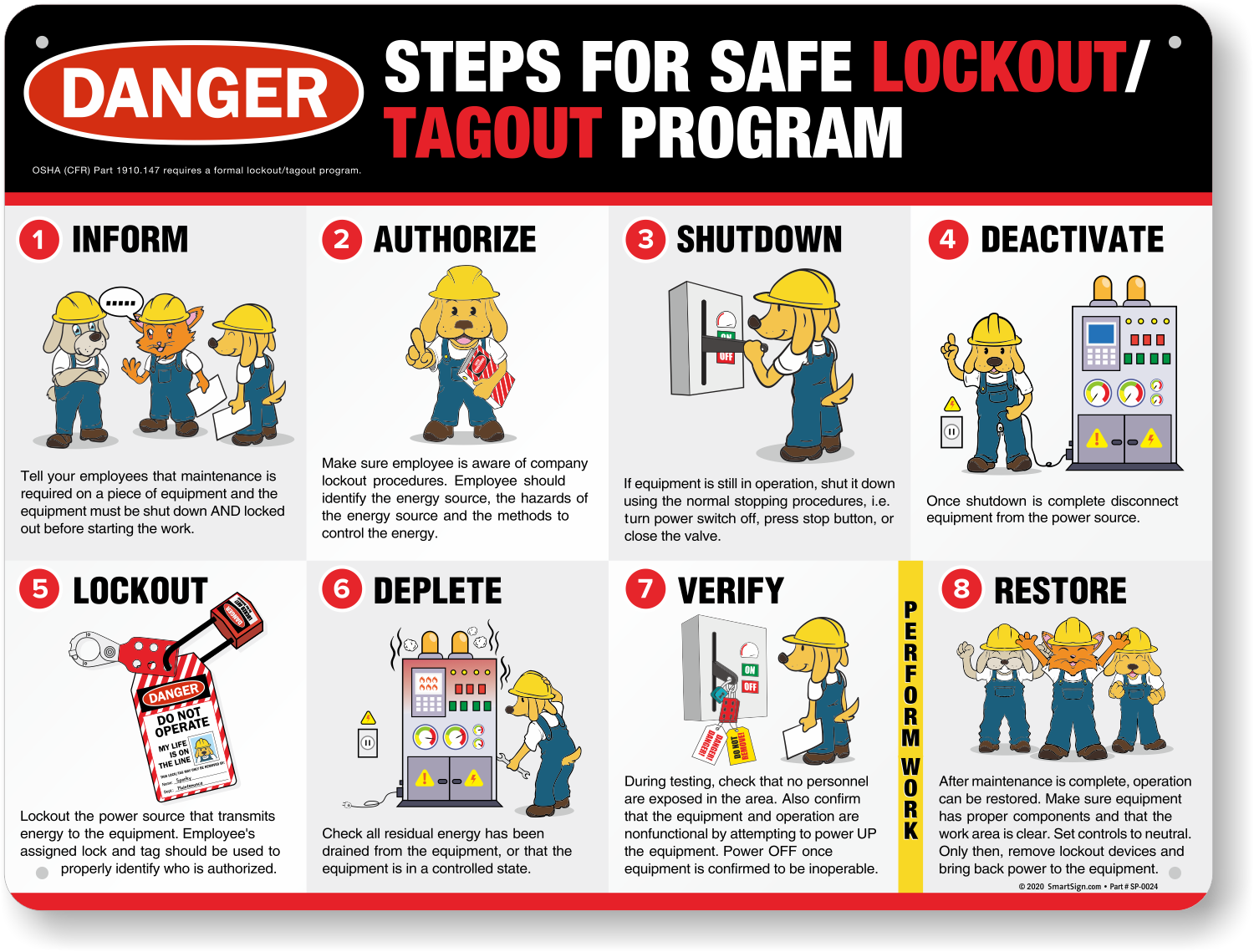
A maintenance technician reaches into a conveyor system for a routine adjustment. The machine powers on unexpectedly. In seconds, a life is altered. This isn’t a hypothetical—it’s a real risk in facilities that fail to enforce a strict lock out tag out (LOTO) procedure.
The core of any effective energy control program lies in six critical steps. These aren’t just bureaucratic checkboxes—they’re engineered barriers between workers and fatal hazards. OSHA cites improper machine servicing as a leading cause of industrial injuries. The solution isn’t guesswork. It’s the lock out tag out procedure 6 steps, executed with precision.
Here’s how top-performing facilities turn LOTO from a paperwork exercise into a culture of life-saving action.
Step 1: Prepare for Shutdown – Know the Machine, Know the Risk Before any shutdown, preparation is non-negotiable. This step begins with identifying the type and magnitude of energy sources powering the equipment. Is it electrical? Hydraulic? Pneumatic? Stored energy in springs or gravity? Each demands a different control strategy.
Workers must consult the machine-specific LOTO procedure, typically documented in the facility’s energy control program. This document outlines the exact isolation points, lockout devices, and sequence of operations.
Common mistake: Assuming all machines follow the same shutdown pattern. A CNC lathe may require three electrical disconnects and one hydraulic valve closure, while a packaging line might have five energy sources across multiple zones.
Workflow tip: Conduct a pre-job briefing. Involve all affected employees. Use diagrams or digital schematics to walk through energy points. For complex systems, a LOTO checklist printed and laminated at the machine station reduces errors.
Step 2: Notify Affected Personnel – Communication Saves Lives
Shutting down equipment impacts more than just the maintenance team. Operators, nearby workers, and even quality control staff need to know the machine is going offline. Failure to communicate leads to accidental re-energization—OSHA’s number one LOTO violation.
The authorized employee must formally notify all affected personnel before initiating shutdown. This isn’t a shout across the floor. It’s a documented handoff—verbal confirmation, logbook entry, or digital alert via CMMS (Computerized Maintenance Management System).
Realistic use case: In a food processing plant, a slicer needs blade alignment. The maintenance lead radios the line supervisor, who then pauses upstream conveyors and alerts sanitation crews working nearby. Only after confirmation does the lockout begin.
Step 3: Shut Down the Equipment Using Normal Controls
This step seems obvious—but it’s where shortcuts start. Equipment must be turned off using standard operational controls: stop buttons, control panels, or shutdown sequences. Never assume a machine is off because it’s quiet.
The key here is using designated procedures, not improvised methods. For example, hitting an emergency stop (E-stop) isn’t sufficient for LOTO. E-stops are safety circuits, not isolation devices. They don’t disconnect power at the source.
Limitation: Some machines have automatic restart features after power loss. Ensure the control circuit is fully de-energized, not just the main drive.
Practical example: A printing press operator uses the main control panel to stop the rollers. The technician then verifies all motion has ceased—no spinning shafts, no residual belt movement—before proceeding.
Step 4: Isolate All Energy Sources
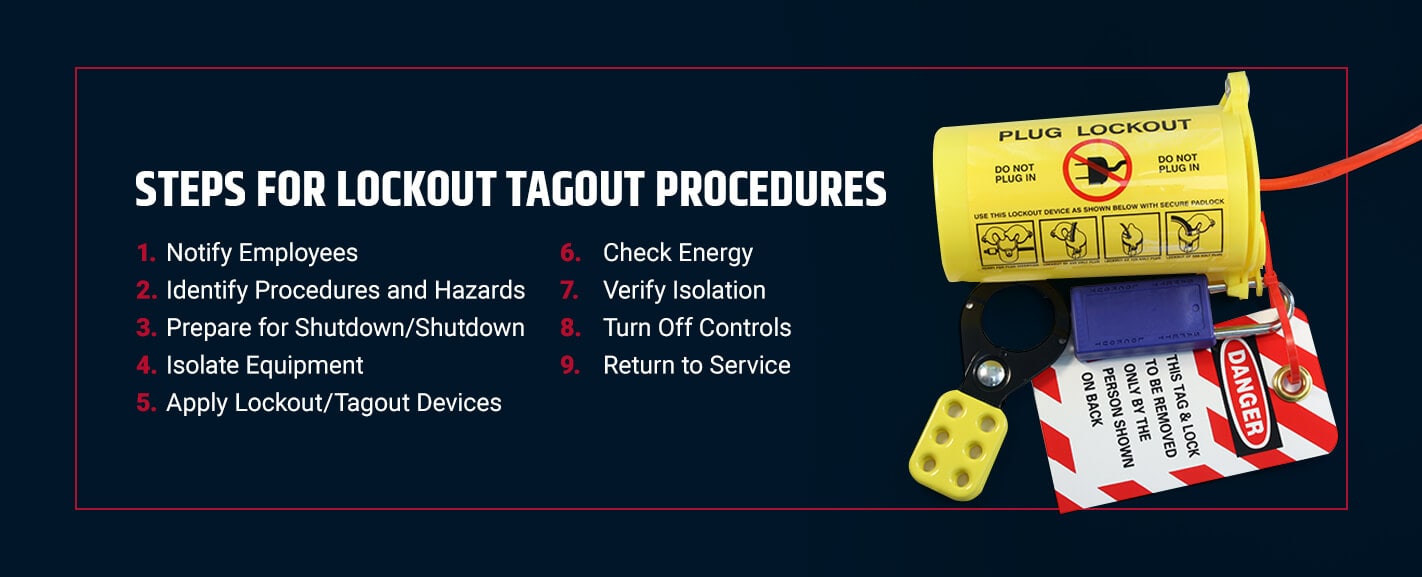
Now comes the physical barrier: isolation. This is where locks and tags enter the equation. Every energy source must be disconnected and secured.
- Electrical: Lock out circuit breakers or disconnect switches
- Pneumatic: Close and lock isolation valves, bleed air lines
- Hydraulic: Depressurize systems, block fluid flow
- Mechanical: Block moving parts, release tension in springs
Each isolation point gets a lock (for control) and a tag (for communication). The lock belongs to the authorized employee—it’s personal and non-transferable. The tag states who locked it, when, and why.
Critical insight: One machine, multiple locks. If three technicians are working on different parts, each applies their own lock. The machine doesn’t restart until all three remove theirs.
Common mistake: Skipping stored energy release. A capacitor in an industrial oven can hold lethal voltage for hours. Always verify zero energy state before proceeding.
Step 5: Apply Locks and Tags to Isolation Devices
This is the heart of LOTO. Locks physically prevent re-energization. Tags provide vital information: name, date, department, and reason for lockout.
Use standardized, durable devices: - Lockout hasps for multi-person jobs - Valve lockouts with universal fit - Circuit breaker locks that can’t be bypassed - Tag materials resistant to oil, heat, and fading
Each lock must be keyed differently or use a master system with strict access control. Tags should include a warning: “Do Not Operate – Work in Progress.”
Workflow tip: Conduct a lock audit. Before starting work, walk the machine and confirm every energy point is locked and tagged. Missing one? Stop. Reassess.
Step 6: Verify Zero Energy State Never assume. Always verify. After locks and tags are applied, the authorized employee must test the machine.
This means attempting to start it using normal controls—while standing clear. If it doesn’t start, that’s a good sign. But it’s not enough.
Next, use test instruments: - Voltage testers on electrical circuits - Pressure gauges on hydraulic lines - Visual inspection for movement or residual force
This verification step confirms all energy has been removed and the system is safe for work.
Realistic use case: An HVAC technician locks out a rooftop unit. After tagging disconnects, they use a multimeter to check for voltage at the terminal block. Zero reading? Verified. Only then do they open the panel.
Limitation: Some systems re-pressurize slowly. Re-check after 5–10 minutes if dealing with compressed gas or thermal systems.
Beyond the Six Steps: Sustaining a LOTO Culture
The six steps are the core, but long-term success depends on culture and reinforcement.
- Training: Annual retraining isn’t enough. Conduct mini-drills quarterly. Simulate lockout scenarios.
- Audit: Surprise audits catch complacency. Check tags for legibility, locks for proper use.
- Documentation: Every LOTO event should be logged—especially if multiple shifts are involved.
- Management Buy-In: When supervisors participate in lockout drills, compliance soars.
A steel mill reduced LOTO violations by 78% in one year by introducing “lockout champions”—experienced technicians who mentor new hires and lead weekly safety rounds.
Common LOTO Failures and How to Fix Them
Even facilities with written procedures fail in execution. Here are the most frequent breakdowns:

| Failure | Risk | Solution |
|---|---|---|
| Skipping notification | Accidental restart | Mandatory sign-in sheet at equipment |
| Using one lock for multiple workers | Unauthorized removal | Group lockout box with individual locks |
| Incomplete energy isolation | Exposure to hidden sources | Machine-specific LOTO maps |
| Illegible or missing tags | Miscommunication | Pre-printed, weather-resistant tags |
| No verification step | False confidence | Enforce test-before-touch protocol |
The cost of failure isn’t just fines—it’s lives. OSHA estimates that LOTO violations prevent 120 fatalities and 50,000 injuries annually when followed correctly.
Tools and Devices That Support the 6-Step LOTO Process Using the right equipment increases compliance and safety. Here are five essential tools:
- Lockout Hasp Kits
- - Allow multiple workers to apply individual locks to one isolation point
- - Made of durable polycarbonate or steel
- - Ideal for circuit breakers and valve stems
- Circuit Breaker Lockouts
- - Fit standard breakers from 15A to 200A
- - Prevent flipping even under force
- - Some include space for tags
- Valve Lockout Devices
- - Universal or size-specific models
- - Secure gate, ball, and butterfly valves
- - Often used with chain extensions for hard-to-reach spots
- Padlocks with Unique Keys
- - Personal locks assigned to each worker
- - Non-conductive bodies for electrical work
- - Color-coded by department
- Group Lockout Stations
- - Centralized boxes storing locks, tags, and instructions
- - Used during complex maintenance
- - Includes checklist and accountability log
Investing in standardized, high-quality LOTO gear reduces improvisation—the root of most near-misses.
Closing: Make the 6 Steps Non-Negotiable
The lock out tag out procedure 6 steps aren’t a suggestion. They’re a sequence engineered to interrupt the path to injury. From preparation to verification, each phase builds a layer of protection.
Compliance starts with belief: that these steps matter every single time. Not “when it’s convenient.” Not “for big jobs only.” Every time.
Train rigorously. Audit relentlessly. Empower every worker to stop work if a step is missed.
Because when the six steps are followed without exception, machines stay off, people stay safe, and operations run with confidence.
Frequently Asked Questions
What are the 6 steps of the lock out tag out procedure? The six steps are: 1) Prepare for shutdown, 2) Notify affected personnel, 3) Shut down equipment using normal controls, 4) Isolate all energy sources, 5) Apply locks and tags, and 6) Verify zero energy state.
Can a single lock be used for multiple workers during LOTO? No. Each worker must apply their own lock. Use a group lockout hasp or box to manage multiple locks on one isolation point.
Why is verifying zero energy critical in LOTO? Because locks and tags can fail or be improperly applied. Verification ensures no hazardous energy remains before work begins.
Who is responsible for implementing the LOTO procedure? Authorized employees—those trained and responsible for executing lockout—are accountable. Affected employees must comply.
What’s the difference between affected and authorized employees in LOTO? Affected employees operate or use equipment. Authorized employees perform maintenance and apply the lockout.
Do all machines require a LOTO procedure? Any machine with hazardous energy that requires servicing or maintenance must have a documented LOTO procedure.
Can tags be used without locks in LOTO? No. Tags alone are not physical restraints. OSHA requires locks for energy isolation; tags are supplementary warnings.
FAQ
What should you look for in Lock Out Tag Out Procedure 6 Steps for Safety Compliance? Focus on relevance, practical value, and how well the solution matches real user intent.
Is Lock Out Tag Out Procedure 6 Steps for Safety Compliance suitable for beginners? That depends on the workflow, but a clear step-by-step approach usually makes it easier to start.
How do you compare options around Lock Out Tag Out Procedure 6 Steps for Safety Compliance? Compare features, trust signals, limitations, pricing, and ease of implementation.
What mistakes should you avoid? Avoid generic choices, weak validation, and decisions based only on marketing claims.
What is the next best step? Shortlist the most relevant options, validate them quickly, and refine from real-world results.


